 Sovereignty Support Movement Sovereignty for West Asia

by the Cradle’s Syria Correspondent, published July 13, 2025
SSM Editor’s Note: If you can stand to look at these images, they are no different than the work of ISIS, Al Qaeda, Jabhat al Nusra and the many other salafist groups large and small that flooded Syria (with assistance from Turkey, Qatar and the Western Powers) at the beginning of the war back in 2011. And if you read between the words, their purpose is not different than the IOF soldiers “cleansing” Gaza today, also assisted by the Western Powers, Turkey and the Gulf Arabs. If you only want to read the words, click here.
Note: This article contains disturbing graphic images and detailed descriptions of violence and civilian harm. Reader discretion is advised.
On the afternoon of 7 March, gunmen from factions affiliated with the Al-Qaeda rooted Syrian government stormed the Alawite village of Sharifa in Latakia governorate. Joined by armed Sunni civilians from neighboring villages, they massacred 30 people and systematically looted and torched homes and shops over the course of three days.
The victims include three women and 27 men. Twelve were over the age of 50, the oldest a 96-year-old farmer.
Residents of Sharifa speaking to The Cradle provided testimony of the events that took place, as well as photographs of the bodies of 24 of the victims.
A pattern of massacres
The massacre in Sharifa was one of many carried out by Syrian government-affiliated armed factions in Alawite villages and cities on Syria’s coast that day.
According to the Syrian Observatory for Human Rights (SOHR), at least 1600 Alawite civilians were murdered in at least 55 separate massacres over a three-day period starting on 7 March. The massacres were accompanied by the systematic looting and burning of Alawite homes. (There are much higher estimates; Mother Agnes Miriam, for Instance)
Many videos of the killing of Alawites were taken and posted to social media by the perpetrators themselves. Dozens of videos went viral showing gunmen forcing unarmed Alawite men to crawl on the ground, barking like dogs, and executing them in the streets.
The Syrian government, led by former Al-Qaeda and ISIS commander Ahmad al-Sharaa (Abu Mohammad al-Julani), promised to investigate the massacres. But four months on, no serious inquiry has materialized, and no arrests have been made, despite clear evidence implicating leaders from factions incorporated into the Syrian Ministry of Defense and General Security.
In one prominent case, video and photographic evidence place Hasan Abu Qasra, the head of the Syrian Government-controlled petroleum company and a close relative of Defense Minister Murhaf Abu Qasra, among the forces coordinating the massacres on the ground.
According to a 30 June investigation by Reuters, “The chain of command led to Damascus.”
Instead of seeking to hold the killers accountable, Syrian Minister of Foreign Affairs Asaad al-Shaibani blamed Alawites themselves. When speaking at the UN three weeks later, he claimed “regime remnants” had carried out the massacres.
After Hayat Tahrir al-Sham (HTS) forces led by Sharaa toppled the government of Bashar al-Assad in December 2024, many warned that such massacres of Alawite civilians would take place.
While under Sharaa’s command, HTS (previously known as the Al-Qaeda affiliated Nusra Front) committed similar massacres throughout the 14-year war to topple the Syrian government. The massacres were driven in part by the Nusra Front’s genocidal ideology, inspired by the sectarian writings of the medieval Islamic scholar Ibn Taymiyyah.
In August 2013, militants from the Nusra Front, ISIS, and the Free Syrian Army (FSA) raided ten Alawite villages in Latakia, slaughtering 190 civilians, including 57 women, 18 children, and 14 elderly men, while taking another 200 hostage, Human Rights Watch reported.
During an interview with Al-Jazeera in 2015, Sharaa (then known as Julani) vowed to kill any Alawites who refused to convert to Sunni Islam.
Making good on this promise became possible once Sharaa took power in Damascus in December 2024.
In the following months, Syria’s Alawites were systematically disarmed, as former Alawite members of the army and security services were required to hand in their weapons as part of a mandatory “reconciliation” process.
In January and February, armed factions affiliated with Sharaa’s HTS-led government carried out a series of massacres of Alawites across the Latakia, Homs, and Hama countrysides, including in the villages of Arzeh and Fahel.
In February, a member of an armed faction belonging to the Ministry of Defense, the Suleiman Shah Brigade, or “Amshat,” told The Cradle, “We would kill every Alawite in Syria now, but the media coverage would be too bad.”
The mass killing of Alawites, now known as the “Coastal Massacres,” including in Sharifa, unfolded just weeks later, on 7 March, under the pretext of suppressing an insurgency led by the “regime remnants.”
The Sharifa Massacre
Sharifa is a small Alawite village located in the Latakia countryside between the Sunni town of Al-Haffa, home to the impressive Saladin Castle, and the M4 Highway, which connects Latakia to Idlib, Aleppo, and northeast Syria.
Residents recounted the chain of events to The Cradle. On the evening of 6 March, gunfire rang out near the village entrance. Two bodies were discovered: Raafat Hawat, a young Alawite from Sharifa, and Hussein Hamsho, a young Sunni from nearby Babanna. Though circumstances remain unclear, the Sunni man’s death became the pretext for the coming attack.
The same night, members of armed factions affiliated with the Syrian government began to gather at the entrance to Sharifa.
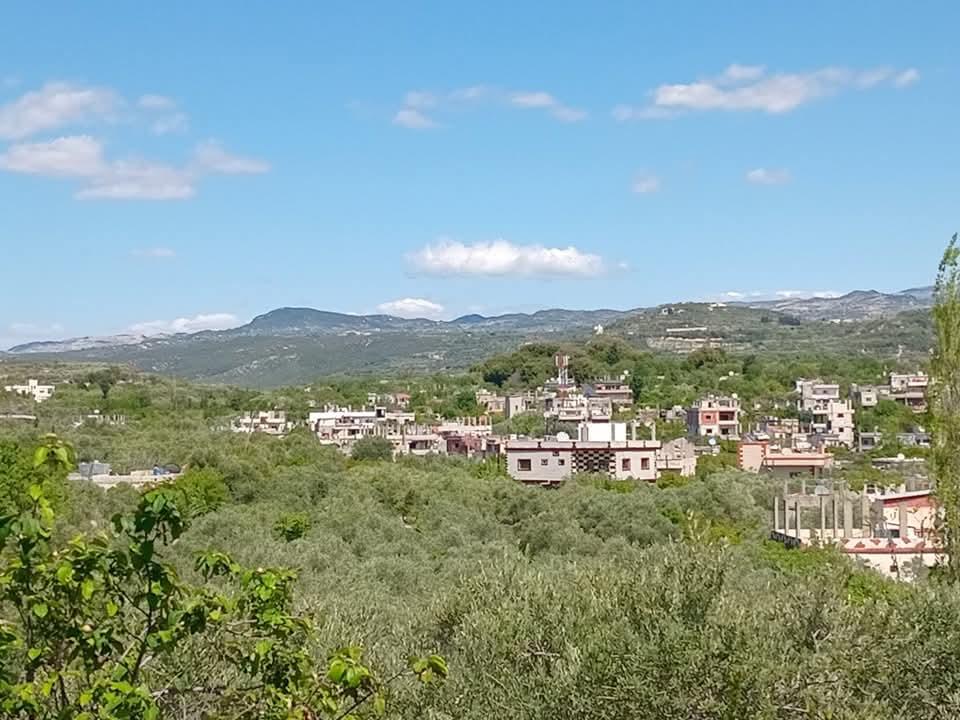
Sharifa village in Latakia countryside
Day one: 7 March
On the morning of the next day, residents of Sharifa began to hear heavy gunfire and calls from the mosques in the neighboring Sunni villages to mobilize men for Jihad.
Most young men in the village fled to hide in the surrounding forests, thinking that government forces were coming to raid the village and carry out arrests. The women and elderly men remained, believing they would not be targeted.
At around 2 pm, following Friday prayers, gunmen from the armed factions and armed civilians from neighboring Sunni villages entered Sharifa. They immediately entered several homes near the entrance of the village and began carrying out executions.
In the first house the gunmen entered, they killed three women: Samar Basima, 48, her sister, Samaher Basima, 51, and their friend Rana Baqawi. All three were found executed with bullets to the head, and the house burned.

Samar Basima, employee at Lattakia University, 48-years-old, born 16/12/1976

Samaher Basima, housewife and worker in the village bakery that burned down, 51-years-old, born 20/03/1973

Rana Baqawi, 48-years-old, sister of Mayor Ziad Baqawi. He buried her and was himself killed the next day.
The gunmen also executed the oldest man in the village, 96-year-old farmer Adam Saeed, after entering his home near the village entrance to search for weapons.

Body of Adam Saeed, farmer, 96-years-old

Adam Saeed
As the gunmen entered homes, they beat and insulted residents, shouting sectarian slurs:
“Alawites, you are pigs.”
“You are not Muslims. You don’t know the Quran.”
“We are Sunni, we can do what we want.”
In one case, gunmen held the arms of an elderly man and repeatedly dunked his head under the water of a fountain in his home until he believed he would suffocate to death.
Radwan Darwish, a 47-year-old grocery store owner, was hiding in his house when the factions came. At first, they didn’t find him, but he later stuck his head out of the door. Gunmen saw him, took him out front of his house, and executed him.
They also executed his father, Mohammad Darwish, a 67-year-old farmer and owner of a mini market, who was with him.

Radwan Darwish, grocery store owner, 47-years-old, 12/12/1978

Mohammad Darwish, farmer, mini market owner, 67-years-old, born 1958
Mazen Baqawi, 47-years old, was also executed. Mazen was a well-known fruit seller who worked across the Latakia region.
When gunmen entered his home, one of them removed his mask, revealing that he was one of Mazen’s employees. Mazen, shocked, asked him, “You really want to kill me?”
The gunman answered, “Yes, and I took off my mask to make sure you never forget my face,” before shooting and killing him.

Mazen Baqawi, citrus and fruit merchant, 47-years-old, born 25/09/1978
Haidar Saloum, who was 30-years-old and worked selling fruit with Mazen, was also executed. Two gunmen beat his head with the butts of their Kalashnikov rifles before shooting him in the face.

Haidar Saloum, citrus and fruit merchant, 30 years old, born 07/10/1994
Maher Aboud, a 46-year-old civil servant in the transportation directorate, and his brother, Yasser, a 50-year-old street coffee seller, were executed together. They first hid in the forest when the factions came, but later decided to return to their homes, thinking nothing would happen.

Maher Abboud, civil servant in the transportation directorate, 46-years-old, born 10/08/1978

Yasser Aboud, street coffee seller, 50-years-old, born 01/01/1975
Hashem Marouf, 57-years-old, worked as a government employee in the electricity department in Al-Haffa for 30 years. When the factions entered the village, Hashem did not believe he was in danger and remained at home.
When the gunmen entered, he greeted them saying, “Welcome. Welcome.” They executed him in his living room, shooting him with three bullets.

Hashem Marouf retired civil servant in the electricity department, 57-years-old, born 10/08/1968
Some of the men were not immediately executed. Instead, they were taken away by gunmen who told the men’s wives that they would be returned after an investigation.
In addition to the killings and abductions, the gunmen looted shops and homes, stealing all the gold, money, and jewelry they could find.
As one woman watched the gunmen loot her home, she was told, “Keep silent or I will fuck you.”
Many homes were burned from the inside after they were looted.


Burned home in Sharifa
Some of the villagers told the gunmen, among them Sunnis from nearby villages, “We are neighbors and brothers. Why are you doing this?”
The gunmen responded, saying, “We are not neighbors.”
One gunman told residents, “We are the Sunnis from Al-Haffa (the nearby town) and we will make hundreds of widows in Sharifa.”
Residents of Sharifa believe their neighbors were motivated by sectarian ideas, for example from the medieval Islamic scholar Ibn Taymiyya, which have spread in Syria since the war began in 2011.
Residents of Sharifa say that even during the 14 years of war, they did not have problems with their Sunni neighbors. They say that when the Syrian army entered Babanna amid clashes with opposition militants from the FSA in 2012, the people in Sharifa received some of those who fled and allowed them to sleep in their homes. They used their own cars to help them reach Latakia safely.
As the looting on 7 March continued, gunmen also stole cars, motorbikes, tractors, tillers, and large containers of olive oil. If they couldn’t steal the olive oil, they emptied the containers on the ground. If they were unable to steal a car, they dismantled it for parts and burned it.
This ensured that the already impoverished residents of Sharifa would have their livelihoods, primarily as farmers, destroyed.
The gunmen also burned the village bakery, and attacked it’s communication towers, stole their cables, and destroyed the solar panels powering them. This eventually cut communication between the village and anyone outside.
At sunset, the attackers withdrew. Survivors emerged from the forests to a scene of devastation.
As one man returned, he saw four corpses in the street leading to his home. The smell of smoke was strong from the burning houses, he told The Cradle.
Another man informed The Cradle that after returning, he frantically sought to contact friends in the neighboring Sunni villages to determine the fate of his elderly father who had been abducted.
Day two: 8 March
The next day, the killings largely stopped while the factions instead focused on looting.
However, one man, Salah Marouf, was abducted by a gunman after he returned to his home from the forests. He was taken to the village square and shot.
Members of the government’s law enforcement arm, the General Security, finally entered the village that afternoon.
They announced their entry on loudspeakers, telling everyone not to be afraid, and that they had come to protect them. This allowed residents to leave their homes and discover the fate of many of the men who had been taken the day before for “investigation.”
The body of Sharif Saad, a 78-year-old retired Arabic teacher, was found on the side of the road just 100 meters from his home. He had been executed with a bullet under his chin. His legs were also burned after the gunmen lit a car next to his body on fire.

Sharif Saad, 78-year-old retired Arabic teacher
Residents were allowed to gather the bodies together, transporting them to a mass grave using a bulldozer brought by the General Security and driven by a Sunni man from Al-Haffa.

Bulldozer transporting bodies to the mass grave site
They were allowed to hold a simple funeral for the victims at the mass grave site later that night.

Mass grave site in Sharifa
One resident of Sharifa told The Cradle he believes the General Security deliberately waited to enter the village until the factions had completed the killing. In the first hours of the massacre, residents had called the General Security, asking for them to respond. However, no one came until the second day. Additionally, after the General Security arrived in Sharifa, its members also participated in the looting.
Further, some members of the same factions who attacked Sharifa were now wearing General Security uniforms. Vehicles from the attack were also seen with the law enforcement convoy.
Some Sharifa residents believe it was the job of the General Security to cover up the evidence of the crimes carried out by the factions the day before. By sending the General Security, but only after the massacre was largely complete, the government could publicly claim it wished to help the Alawite victims while also enabling the faction’s crimes.
On the evening of 8 March, just as the General Security left the village, more gunmen from the factions returned, showing further collaboration between the General Security and the factions.
When the factions returned, many residents feared the killings would resume, so they fled to the forests above the village once again. This time, the elderly women and men came with them, hiding in the forest throughout the night.
Day three: 9 March
General Security personnel summoned village mayor Ziad Baqawi to help distribute bread. Shortly afterward, a convoy of heavily armed fighters from the M4 highway – the direction of Idlib – passed through the village.
Residents heard them yell: “You want to give Alawite pigs bread?” Then, gunshots.
When the convoy left, the residents discovered that the mayor and two other Alawite men from the village, Haitham Hamama and Rami Nzeiha, had been executed by the armed men in the convoy.
Mayor Ziad Baqawi, who was also a barber, was the brother of Rana Baqawi. She was one of the three women executed at the entrance of the village on the first day. Ziad was killed one day after burying his sister in the mass grave.

Sharifa mayor and barber Ziad Baqawi
Haitham Hamama, a 68-year-old farmer and bus driver, had come to take bread from Ziad and the members of General Security who were with him. He was put in a line with the other men and shot.

Haitham Hamama, farmer and bus driver, 68-years-old, born 1957
The third man who was executed, Rami Nzeiha, was killed after the armed men in the convoy came to his home looking specifically for him. They dragged him from his home and lined him up along with the mayor and Haitham to execute them all.
Rami was first injured the day before, on Saturday, 8 March. He was at home with his wife and children when gunmen entered their home to loot it. They ordered him to go to the attic and shot him. Believing he was dead, they left the home, but the bullet only pierced Rami’s hand. He was bleeding badly, so a neighbor rushed him to the hospital in Al-Haffa.
The doctor treating him asked if he knew who had shot him.
Rami replied, “Yes – and I remember his face well.”
The next day, the convoy came directly to his house and called his name. Residents believe the doctor informed the killers.

Rami Nzeiha, farmer, 47-years-old, 09/09/1978
After the three men were executed, terror again spread through Sharifa. Many people fled to the forests again, thinking new massacres would begin.
The convoy of armed fighters from Idlib continued to two nearby Alawite villages, Brabishbo and Jobar, where they carried out another massacre. One resident of Sharifa understands that 47 people were killed in Brabishbo, including some children, and seven were killed in Jobar. According to his information, all the killing was done in one and a half hours.
On the third day, two additional men were kidnapped from Sharifa. A group of armed men came to the village and took Ahmed Khaddour and Adham Salloum, saying they needed to ask them questions. Their whereabouts are still unknown.
Adham Salloum was specifically summoned to the checkpoint by the commander of the local faction from Al-Haffa. His family advised him not to go, but he went because he felt that he had done nothing wrong, and so nothing would happen.
He was taken to an unknown location and is still missing at the time of writing.

Adham Salloum, abducted, fate unknown
Later that day, General Security again summoned villagers – men were forced to stand in a line, women to kneel. Their IDs and phones were confiscated. An hour later, the faction leader standing beside a General Security commander declared: “Oh, Sharifa village, that’s enough killing for now. It’s over. I don’t want any more dead.”
Residents of Sharifa tell The Cradle they believe Syrian authorities ordered an end to the killing and looting on the third day due to international pressure, in particular from France, after news had spread widely of the massacres of Alawites taking place throughout the coastal regions.
Will there be justice?
Rather than pursue arrests of those who carried out the massacre of Alawites across the Syrian coast in March, President Sharaa announced an “investigation committee.” Its report, due 30 days after the massacre, was delayed by another three months. At the time of writing, the new deadline has also passed, and the report remains unpublished. Sharifa residents say they’ve identified many of the attackers and passed names to the committee, despite threats to remain silent. But few believe justice will come.
Though their livelihoods have been destroyed, the Syrian government has also sent no aid groups to assist the survivors.
One survivor speaking with The Cradle blames not only the Syrian government and the extremists in the ranks of the army and security forces, but also the US and European countries.
After grooming Sharaa to take power in Damascus, western leaders have continued to praise him, including in the wake of the genocidal massacre of Alawites he had long promised to carry out. It is no accident that billboards are now seen in Damascus showing President Trump smiling alongside the former ISIS commander.
Additional victims:

Nizar Baqawi, retired civilian, cousin of Ziad and Rana Baqawi

Yasser Skaif, civil servant in the electricity directorate and repair truck driver, 55-years-old,11/12/1969

Ali Darwish, accountant in a private company, 37-years-old, born 07/04/1987

Wadih Saad, farmer, cousin of Sharif and Zareef Saad

Melad Jadid, unemployed, handicapped, 29-years-old, born 1995

Malik Mukhais, lottery ticket seller, 55-years-old, born 01/01/1970

Bilal Sheikh Ali, retired civil servant, age 75, born 06/10/1950

Zareef Saad, farmer, 78-years-old, 20/08/1947. Cousin of Sharif Saad and Wadih Saad.

Zain Saeeda, teenage student. He is not from Sharifa, he was visiting a friend in the village that day.

Mazen Baqawi, Haidar Saloum, Zain Saeeda, Nizar Baqawi


